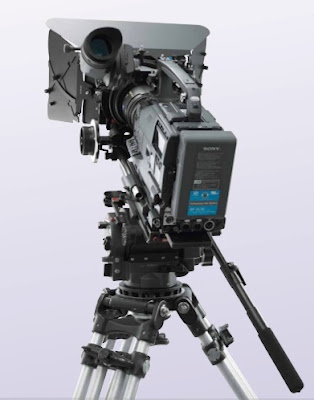
The highly respected HDW-F900 camcorder has now been refined into the next-generation HDW-F900R, offering a variety of further enhanced functionalities. The HDW-F900R camcorder records images in accordance with the CIF (Common Image Format) standard, which specifies a sampling structure of 1920 x 1080 active pixels (horizontal x vertical). Plus, as well as recording at 24P, the HDW-F900R camcorder is switchable to record at 25P, 29.97P progressive scan, and also at 50 or 59.94 Hz interlaced scan. The camcorder also provides a comprehensive range of features for creative shooting such as enhanced gamma features and colorimetry controls. Plus, the design of the HDW-F900R is highly compact and lightweight, giving users higher levels of mobility and comfort when shooting. To further enhance the creative and operational versatility of the camcorder, a wide range of optional accessories are available. These include a picture cache board, a 2-3 Pull-down and down converter board, and a slow-shutter board. In combination with its renowned 24P capability and attractive cost efficiency, all of these great functionalities make the HDW-F900R the perfect solution for shooting television series , documentaries, commercials, as well as motion pictures.
Highlight
Camera image capture complies with the ITU-R, BT 709-3 Recommendation for High Definition Production and International Programe Exchange
Equipped with 2/3" type 2,200,00 sensor FIT imager, providing high resolution 16:9 images
Compact, lightweight and robust body design with cinematography accessories attached
Continuous recording time of up to 50 minutes (24P mode)
Newly developed LSI for ADSP (advanced digital signal processor) improves picture quality, ensuring picture stability and operational reliability while reducing total power consumption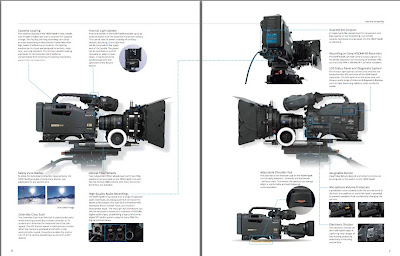
Showing posts with label film. Show all posts
Showing posts with label film. Show all posts
Wednesday, November 7, 2007
CineAlta 24P HDCAM Camcorder( without viewfinder)

Tuesday, August 21, 2007
Digital-Film Camera Differences

Powering the camera:
Film: Takes disposable batteries that require infrequent replacement.
Digital: Takes one or more of a variety of battery types--both disposable and rechargeable--that require frequent replacement or recharging.
Recording pictures:
Film: Uses film, which comes in various frame sizes and different sensitivities to light.
Digital: Uses a fixed, light-sensitive, silicon chip that comes in two varieties: CCD or CMOS. This chip determines the frame size and the light sensitivity of the camera. You can simulate the effects of using different types of film via settings within the camera.
 Framing shots:
Film: Uses an optical viewfinder that shows 97 to 100 percent of the scene.
Digital: Uses an optical viewfinder, as well as an LCD that displays 100 percent of the scene. But an LCD can be hard to see in bright light and uses a lot of battery power. Many cameras substitute the optical viewfinder with the kind of electronic viewfinder (EVF) that is used on camcorders. Photographers who are used to optical viewfinders don't always like EVFs, so try before you buy.
Digital: Uses an optical viewfinder, as well as an LCD that displays 100 percent of the scene. But an LCD can be hard to see in bright light and uses a lot of battery power. Many cameras substitute the optical viewfinder with the kind of electronic viewfinder (EVF) that is used on camcorders. Photographers who are used to optical viewfinders don't always like EVFs, so try before you buy.
Snapping shots:
Film: Instantaneous capture.
Digital: Varies wildly, depending upon image size, file format, media type, memory available for temporary storage, sensor type, and speed of autofocus
Storing pictures:
Film: Stores images directly on the capture medium (film), which is single-use and supplies a fixed number of frames per roll.
Digital: Stores images as digital files on reusable memory cards or discs, both of which come in various capacities and can hold a variable number of frames per card.
JPEG
Small and fast for capture but has file compression that may introduce artifacts that degrade image quality.
RAW
Smaller than TIFFs and more flexible for postcapture retouching. Not offered on all cameras, and special software is required to read them.
TIFF
Large files that can slow down your shooting and fill up your media but have no compression artifacts.
Subscribe to:
Posts (Atom)


